1
/
of
14
Etsy
Hand-Painted White Tara Paubha Thangka | Newari Buddhist Art with Silk Brocade | Master Quality
Hand-Painted White Tara Paubha Thangka | Newari Buddhist Art with Silk Brocade | Master Quality
Regular price
$1,037.99 CAD
Regular price
$2,074.77 CAD
Sale price
$1,037.99 CAD
Unit price
/
per
Shipping calculated at checkout.
Couldn't load pickup availability
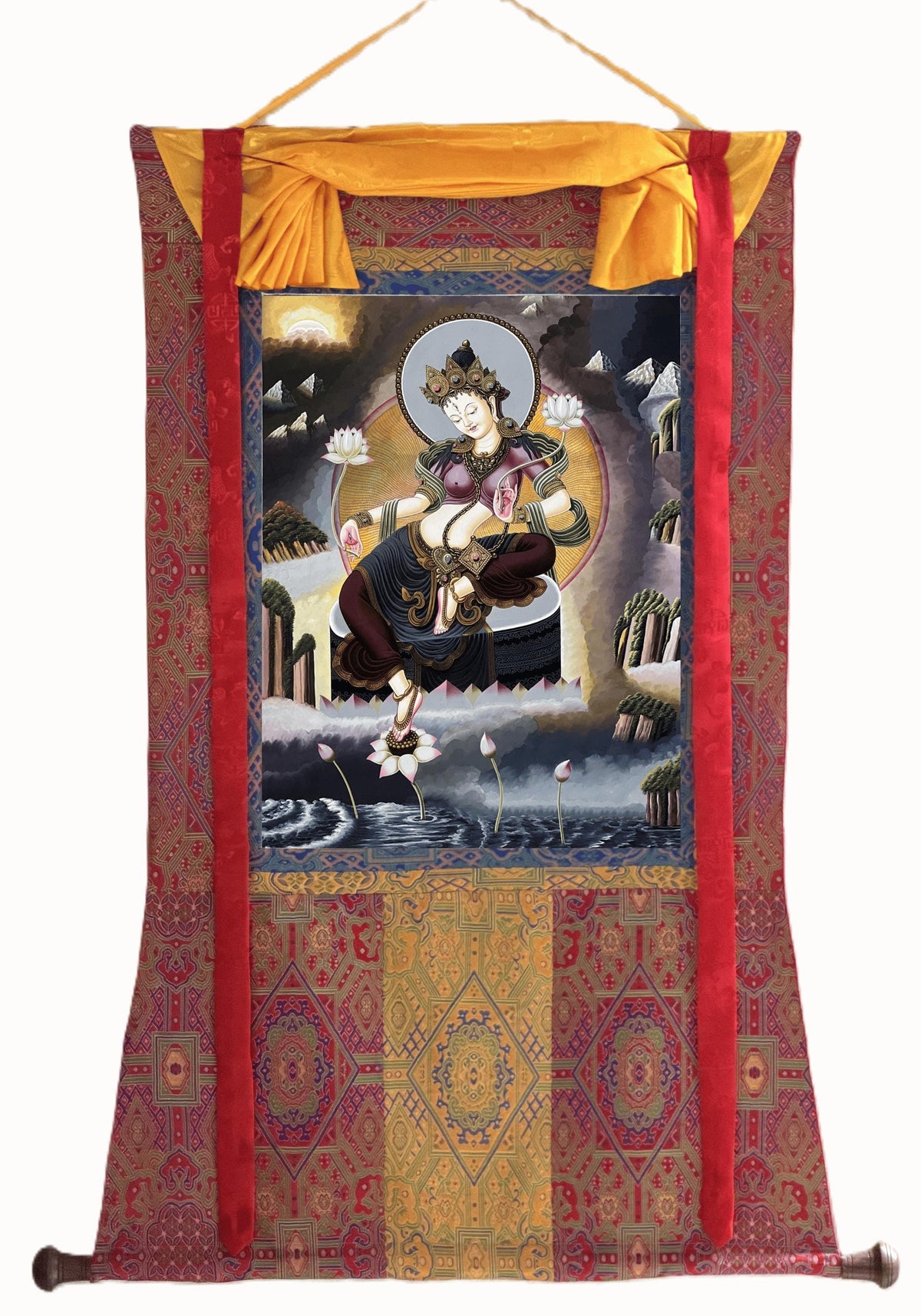
This exquisite **White Tara Newari Paubha Thangka** is an original, master-quality Buddhist painting created in the traditional **Newari Paubha art style of the Kathmandu Valley, Nepal**.
Meticulously hand-painted on **premium handmade cotton canvas using natural stone pigments**, the artwork depicts **White Tara**, one of the most revered female figures in Mahayana and Vajrayana Buddhism. Her peaceful white form embodies **compassion, serenity, wisdom, healing, and longevity**.
The painting measures **16 × 22 inches (41 × 56 cm)** and is beautifully mounted in **traditional silk brocade**, resulting in an overall size of approximately **34 × 46 inches (86 × 117 cm)**.
The precise linework, balanced composition, delicate ornamentation, natural pigmentation, and serene expression of Tara reflect the refined craftsmanship associated with traditional Newari sacred painting.
This is an **original hand-painted artwork, not a print**. Each painting is individually created by hand, making every piece unique.
## White Tara – The Compassionate Mother
**White Tara**, known in Sanskrit as *Sita Tara*, is one of the most beloved manifestations of Tara.
Tara is often revered as a compassionate mother figure whose enlightened activity responds to the suffering of sentient beings. White Tara is particularly associated in Tibetan Buddhist traditions with **long life, healing, peaceful activity, compassion, and wisdom**.
Her tranquil expression and meditative presence make her imagery especially meaningful for spaces dedicated to prayer, contemplation, and meditation.
## White Color – Purity and Peace
White Tara‘s luminous **white body** is central to her iconography.
White symbolizes **purity, clarity, peaceful enlightened activity, and freedom from obscurations**.
Her calm appearance communicates a compassionate presence rather than forceful activity, making White Tara imagery particularly associated with serenity and contemplative awareness.
## Seven Eyes – All-Seeing Compassion
One of White Tara‘s most distinctive iconographic features is her **seven eyes**.
In addition to the two eyes on her face, she traditionally has:
* One eye on her forehead
* One eye in each palm
* One eye on each sole of her feet
Together, these seven eyes symbolize **vigilant wisdom and compassionate awareness directed toward sentient beings in every direction**.
They express a form of compassion that does not merely observe suffering but remains continuously attentive to it.
## Third Eye – Transcendent Wisdom
The eye on White Tara‘s forehead represents a level of perception beyond ordinary physical sight.
It can be understood as symbolizing **wisdom, insight, and awakened awareness**—the ability to perceive beyond superficial appearances.
Together with the eyes on her hands and feet, it reinforces White Tara‘s identity as a figure of compassionate and discerning awareness.
## Hands and Feet – Compassionate Activity
The eyes appearing on White Tara‘s **palms and soles** carry additional symbolic meaning.
The hands suggest compassionate action, while the feet can symbolize movement along the spiritual path. The presence of eyes upon them indicates that enlightened activity is accompanied by **wisdom and awareness**.
This combination of seeing and acting is an important aspect of Tara‘s compassionate symbolism.
## Lotus – Purity and Awakening
White Tara is traditionally accompanied by sacred **lotus flowers**, one of Buddhism‘s most important symbols.
A lotus grows from muddy water but opens above the surface unstained. It therefore represents the possibility of developing **purity and awakening while living within the conditions of ordinary existence**.
The lotus imagery complements Tara‘s serene form and reinforces the painting‘s themes of spiritual development and enlightened awareness.
## White Tara and Long-Life Practice
White Tara has an especially important connection with **longevity practices** in Tibetan Buddhism.
She is traditionally invoked in practices associated with long life, healing, and the removal of obstacles to spiritual practice.
For this reason, White Tara paintings are often chosen for **meditation rooms, Buddhist altars, prayer spaces, and long-life practices**.
These associations belong to Buddhist religious tradition and symbolism and should not be understood as guarantees of medical or physical outcomes.
## Compassion and Healing Symbolism
White Tara represents a particularly gentle and nurturing expression of compassion.
Her healing symbolism can also be understood spiritually: the transformation of **fear, suffering, confusion, and mental obscurations through compassion and wisdom**.
Her peaceful presence makes this Paubha especially appropriate for contemplative spaces where calmness and focused awareness are desired.
## Traditional Newari Paubha Art
A defining feature of this artwork is its execution in the traditional **Newari Paubha style**.
**Paubha**, sometimes written *Pauba* or *Pauva*, is a centuries-old sacred painting tradition preserved by the **Newar communities of Nepal‘s Kathmandu Valley**.
Paubhas traditionally depict Buddhist and Hindu deities, mandalas, and other sacred subjects and have historically served ritual, devotional, and contemplative purposes.
Although closely related historically and artistically to Tibetan Thangka painting, **Newari Paubha is a distinctive Nepalese artistic tradition with its own aesthetic heritage**.
The refined drawing, elaborate ornamentation, carefully controlled composition, and meticulous detailing found in Paubha painting reflect generations of artistic knowledge preserved in the Kathmandu Valley.
## Natural Stone Pigments
This White Tara is painted on **handmade cotton canvas using natural stone pigments**.
Traditional stone-based colors provide rich tonal depth and an organic visual character, particularly well suited to sacred Himalayan painting.
Creating the delicate facial features, ornaments, textiles, lotus flowers, halos, and surrounding decorative elements requires extremely fine brushwork and considerable patience.
Because each artwork is painted individually, subtle variations in pigment density, brushwork, linework, and minute decorative details are natural characteristics of genuine handmade Paubha art.
## Traditional Silk Brocade
The painting is beautifully mounted in **traditional silk brocade**, completing its classic Himalayan presentation.
The inner White Tara painting measures **16 × 22 inches (41 × 56 cm)**, while the complete artwork with silk brocade measures approximately **34 × 46 inches (86 × 117 cm)**.
The richly textured textile mounting complements the intricate painting and gives the complete artwork a substantial presence when displayed on an altar or wall.
## Spiritual Meaning
This White Tara Paubha brings together several interconnected Buddhist qualities:
**Compassion** – Tara‘s fundamental aspiration to respond to suffering.
**Wisdom** – expressed through her awakened awareness and seven eyes.
**Purity** – symbolized by her white body and lotus imagery.
**Healing** – traditionally associated with White Tara practices.
**Longevity** – one of her most important traditional associations.
**Serenity** – reflected in her peaceful expression and meditative presence.
**Awakening** – represented through the lotus and the broader symbolism of enlightened awareness.
For practitioners, this painting can provide a meaningful visual support for **meditation, prayer, contemplation, and White Tara practice**.
## Artwork Details
**Subject:** White Tara / Sita Tara
**Tradition:** Mahayana & Vajrayana Buddhism
**Art Style:** Traditional Newari Paubha
**Painting Size:** 16 × 22 inches (41 × 56 cm)
**Overall Size with Silk Brocade:** 34 × 46 inches (86 × 117 cm)
**Surface:** Premium Handmade Cotton Canvas
**Colors:** Natural Stone Pigments
**Mounting:** Traditional Silk Brocade
**Technique:** Traditional Hand-Painted Paubha
**Quality:** Master Quality
**Condition:** New
**Origin:** Hand-Painted in Nepal
**Orientation:** Vertical
**Artwork Type:** Original Hand-Painted Artwork
## Perfect For
This master-quality White Tara Paubha is particularly suitable for **Buddhist altars, meditation rooms, prayer spaces, Dharma centers, yoga studios, peaceful home interiors, or collections of Newari and Himalayan sacred art**.
It can also make a meaningful spiritual gift for someone interested in **White Tara, Buddhist meditation, compassion practices, Nepalese culture, Newari Paubha painting, or traditional Himalayan art**.
More than decorative artwork, this **White Tara Newari Paubha** represents **compassion, purity, serenity, wisdom, healing, and longevity**, while preserving the living artistic heritage of the Kathmandu Valley.
## Important Information
* This is an **original hand-painted Paubha artwork, not a print**.
* Every painting is individually created by hand, so no two pieces are completely identical.
* Minor variations in brushwork, natural pigments, silk brocade pattern, and stitching are characteristics of handmade craftsmanship.
* The inner painting measures **16 × 22 inches (41 × 56 cm)**; the overall **34 × 46 inches (86 × 117 cm)** measurement includes the silk brocade.
* Colors may appear slightly different due to photography, lighting conditions, and individual screen settings.
* Natural pigments and intricate details generally appear richer when viewed in person.
* Please review all listing photographs carefully before ordering.
* The artwork will be carefully rolled and securely packed inside a protective PVC tube for safe transportation.
* Buyers are responsible for applicable import duties, customs taxes, or other fees imposed by their destination country.
Share
No reviews